
Why Your Travel Agency Needs a Professional Website in 2026 (Instagram Isn't Enough)
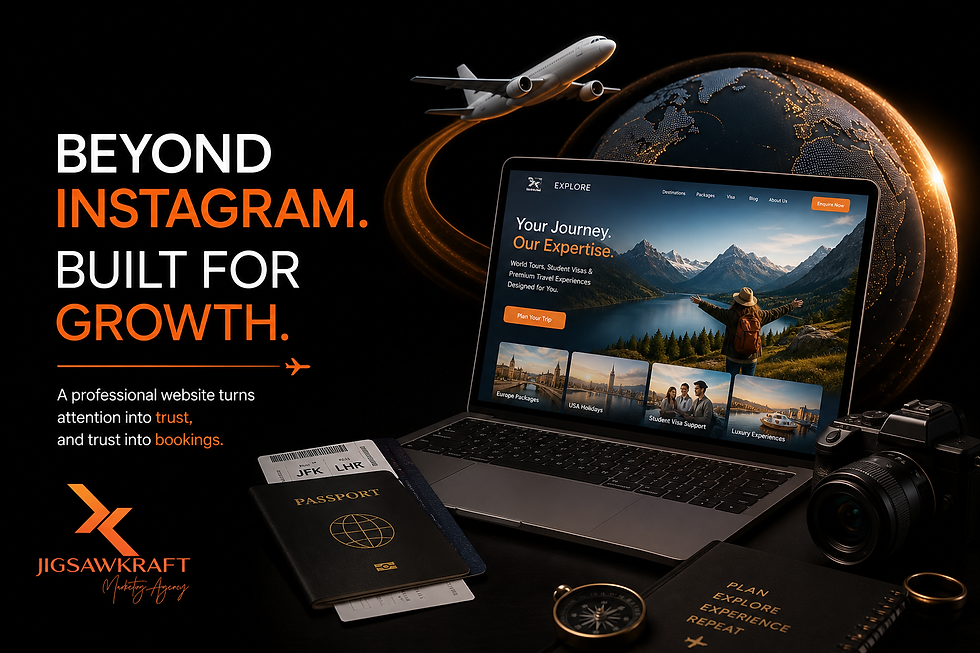
Your travel agency is active on Instagram.
You post destination reels.
You upload Europe package carousels.
You put Dubai, Bali, USA, and student visa updates in your Stories.
Some people DM you.
Some ask for prices.
A few disappear.
A few waste time. A few actually convert.
And then the thought comes:
“Do we really need a website right now? Isn’t Instagram enough?”
For most travel agencies in 2026, that question is exactly where growth starts slowing down.
Because Instagram can help people discover you.
But Instagram is a terrible place to build a serious, scalable travel business.
A professional travel agency website does what Instagram cannot:
builds trust,
organizes your offers,
helps you rank in Google,
supports international growth,
captures leads properly,
and turns scattered attention into a real sales system.
This matters even more if your goal is to grow in the U.S. market.
U.S. inbound travel is expected to resume growth in 2026, with international visitation projected to rise to 70.5–70.6 million depending on the forecasting source, and major events like the 2026 FIFA World Cup are expected to support demand .
At the same time, the U.S. State Department says visa appointment timing varies by post, workload, and staffing, which means travelers and students research more carefully before choosing who to trust .
That creates both an opportunity and a challenge.
If your travel business wants to sell world tours, U.S. itineraries, student visa support, or premium travel planning, you need more than a social presence.
You need a digital asset that looks professional, explains your offer clearly, ranks in search, and makes buyers feel safe enough to inquire.
At Jigsawkraft, we help businesses build websites and growth systems that are made for lead generation—not just for looking nice. And if you are a travel agency trying to grow in a competitive market, especially the U.S., your website can become your strongest trust and conversion asset.
In this guide, we’ll break down:
why a website matters more than ever for travel businesses,
why Instagram alone limits growth,
what a modern travel agency website must include,
how a website supports SEO, social media, and U.S. expansion,
and how Jigsawkraft can help travel brands build a stronger digital foundation.
Let’s get into it.
Quick Summary
If you only remember 5 things from this article, remember these:
Instagram helps discovery, but your website closes trust and leads.
A travel agency website is not just a brochure; it is your offer, trust, SEO, and lead-capture system.
If you want to grow in the U.S. market, your website must feel credible, easy to navigate, and internationally trustworthy.
Your website should work together with SEO, social media, and content—not replace them.
If your travel business depends only on Instagram DMs, you are building on rented land.
Table of Contents
Why Instagram Isn't Enough for a Travel Agency in 2026
Instagram is useful.
Let’s be fair.
For a travel business, it helps with:
showing destinations visually,
publishing reels,
creating aspiration,
staying active,
and building top-of-funnel awareness.
But awareness is not the same as business infrastructure.
Here is the core problem:
Your Instagram account is a distribution channel.
Your website is a business asset.
That difference matters.
If your business depends only on Instagram:
your leads live in DMs,
your offers are hard to organize,
your customer journey is messy,
your SEO visibility is weak,
your authority feels shallow,
and your growth depends on a platform you do not own.
The rented land problem
Think of it this way:
Asset Type | Website | |
Ownership | rented platform | owned digital asset |
Reach control | algorithm-controlled | SEO + direct traffic + search |
Lead capture | messy, DM-based | forms, funnels, landing pages |
Offer presentation | fragmented | structured and scalable |
Long-term discoverability | weak | strong if SEO is done well |
Trust building | partial | full |
If Meta cuts your reach, suspends your account, or changes how profiles are shown, your business gets hit immediately.
If you have a professional website, you still control:
your service pages,
your offers,
your inquiries,
your content,
and your long-term visibility.
That is why serious travel agencies use Instagram as a feeder—not as the whole system.
Why a Professional Travel Agency Website Matters More in the U.S. Market
Growing in the U.S. market is different from growing only in your local city.
When you are trying to attract:
U.S.-bound travelers,
student visa inquiries,
families planning international trips,
or U.S.-based buyers looking for a travel specialist,
your trust burden becomes much higher.
Why?
Because buyers ask questions like:
Is this company real?
Are they organized?
Can I trust them with my travel documents or planning?
Do they understand my destination and my needs?
If something goes wrong, can I contact them properly?
A weak Instagram-only presence often fails these trust tests.
A proper website helps answer them before the first call.
The U.S. market especially rewards:
clarity,
process,
professionalism,
fast access to information,
and confidence signals.
That is true for both B2C and B2B travel-related services.
For example, if your agency offers:
U.S. tour packages,
custom itineraries,
family travel planning,
business travel planning,
student visa support,
or relocation/newcomer assistance,
your buyers will often compare multiple providers before converting.
And where will that comparison happen?
Not only on Instagram.
On:
Google Search,
your website,
reviews,
landing pages,
and brand credibility signals.
This is why a travel website is not optional if your business wants to grow internationally.
What a Travel Agency Website Should Actually Do
A lot of travel businesses build websites that are just digital visiting cards.
That is not enough.
A serious travel agency website should perform at least 5 jobs.
1. Clarify your offer
Visitors should immediately understand:
what kind of travel services you provide,
who you serve,
what destinations or use cases you specialize in,
and what they should do next.
Good example:
U.S. family travel planning
student visa support for U.S. universities
custom world tour itineraries
premium group departures
business + leisure travel planning
Bad example:
“We provide all travel solutions”
Too broad. Too vague. Too forgettable.
2. Build trust fast
Trust is one of the biggest reasons websites matter.
Your site should show:
years of experience,
destination expertise,
testimonials,
process steps,
FAQs,
team information,
and easy contact options.
If you also want to grow through content, your site should clearly connect those trust signals to your offer.
3. Capture structured leads
DMs are messy.
A website lets you capture leads through:
inquiry forms,
destination-specific landing pages,
consultation requests,
document-check requests,
and itinerary planning forms.
That means better follow-up, better qualification, and better sales consistency.
4. Support search visibility
People search things like:
travel agency for USA tour packages
student visa consultant for USA
best website for travel agency
travel marketing agency
digital marketing for travel business
Without a proper website, you do not have enough owned pages to rank for those searches.
A strong website gives you:
service pages,
niche landing pages,
blogs,
destination pages,
and authority pages.
5. Convert attention into action
A travel reel may create desire.A website turns that desire into:
booked consultations,
document reviews,
itinerary discussions,
or direct leads.
That is a very different job.
Instagram vs Website: What Each One Should Do
The smartest travel brands do not choose one or the other.They assign each platform a role.
Channel | Main Job |
attention, discovery, visual storytelling | |
Website | trust, offer clarity, SEO, lead conversion |
SEO/blogs | capture demand when people search problems/questions |
Social media management | consistency, top-of-funnel and audience engagement |
Email/CRM | nurturing, follow-up, conversion |
So the question is not:
Website or Instagram?
The question is:
Are you using Instagram to feed a stronger website funnel, or are you trying to run the whole business from social media?
If it is the second one, growth will eventually hit a ceiling.
The 10 Must-Have Features of a Travel Agency Website in 2026
If a travel company wants a professional website that actually helps growth, these are the essentials.
1. Clear homepage positioning
Within a few seconds, users should understand:
what you do,
who you help,
and what type of trips/services you specialize in.
2. Dedicated service pages
Instead of one generic “services” page, build separate pages for:
U.S. travel planning
student visa guidance
honeymoon / family travel
world tours
custom itineraries
corporate travel support
This helps SEO and conversions.
3. Trust signals everywhere
Include:
testimonials,
reviews,
destination expertise,
response promises,
and process clarity.
4. Mobile-first design
Travel research often starts on mobile.
A clunky mobile experience kills trust immediately.
5. Strong lead forms
Use forms like:
Plan My U.S. Trip
Get Student Visa Guidance
Request a Custom Itinerary
Book a Travel Consultation
6. Destination / niche landing pages
Example:
USA family tours
student visa support for U.S. admissions
New York + California packages
international student pre-departure support
7. FAQ sections
These help users and also improve answer-style content clarity.
8. Blog / resource section
This is where SEO and AI discoverability start compounding.
9. Fast loading and clean structure
A professional website should feel reliable.
10. Consistent brand presentation
Your brand, website, social media, and service pages should feel aligned.If they don’t, trust drops.
If your current website is underperforming, this is also where broader website strategy matters. See: Why Your Website Isn't Generating Leads (and How to Fix It).
How a Website Improves SEO, Leads, and AI Discoverability
This is the part many agencies miss.
A website is not just useful because it looks professional.
It is useful because it creates indexable, discoverable, answerable content surfaces.
Why this matters in 2026
If someone searches:
travel agency website design
travel business digital marketing
how to grow a travel agency in the U.S.
website for student visa agency
digital marketing for travel consultants
you need pages that can actually rank and be referenced.
Instagram posts do not do this nearly as well.
A website helps you with:
1. Search demand capture
You can publish:
service pages,
cost guides,
growth strategy blogs,
comparison posts,
and niche use-case pages.
2. Better AI-readability
If your content is structured with:
clear definitions,
comparison tables,
short direct answers,
FAQs,
and practical frameworks,
it becomes easier for AI systems to summarize and cite.
3. Better internal linking
You can connect:
website development,
SEO,
branding,
content creation,
and social media services
into one coherent trust system.
For example, a travel agency owner reading this blog might also need:
That is exactly how a real lead-generation content system should work.
4. Better conversion paths
A blog can attract.
A service page can convert.
A form can capture.
A follow-up process can close.
That full system starts with a proper website.
Common Mistakes Travel Agencies Make With Their Websites
1. Using a generic template with no positioning
This makes every agency look the same.
2. Showing destinations but not business clarity
Beautiful visuals alone do not explain your offer.
3. No U.S.-specific credibility signals
If you want U.S. market growth, your website should not feel completely generic or purely local-only.
4. Poor CTA structure
If every page just says “Contact us,” conversions stay weak.
5. No content strategy
Without blog content, comparison content, and niche authority pages, search growth stays limited.
6. Treating social media as the main website
This is the big one.
Instagram is a layer.
Not the foundation.
7. Weak service segmentation
Travel businesses often sell multiple services, but their site structure does not reflect that clearly.
Example: Student visa, world tours, custom itineraries, family travel, and premium travel should not all feel mashed together on one generic page.
How Jigsawkraft Can Help a Travel Agency Grow
If you run a travel agency and want to grow more seriously, you usually do not need “just a website.”You need a website that is part of a lead system.
At Jigsawkraft, we can help travel businesses with:
Website strategy and development
We build websites that are designed to:
look credible,
convert inquiry traffic,
support SEO,
and organize complex service offers properly.
Explore: Website Development
SEO for long-term demand capture
If people are searching travel, visa, itinerary, or agency-related queries, SEO helps you build owned visibility instead of depending only on reach.
Explore: SEO Services
Social media management that supports the website
Instagram should drive traffic to your website—not replace it.
Explore: Social Media Management
Content creation and authority building
Travel businesses need:
destination content,
planning content,
trust content,
and growth content.
Explore: Content Creation
Branding and positioning
If your brand currently feels generic, that affects everything from inquiries to conversion rates.
Explore: Branding
A travel agency trying to grow in the U.S. or internationally needs all of these pieces to work together.
And that is exactly why random digital activity rarely works as well as a proper growth system.
FAQs
Can a travel agency grow using only Instagram?
A travel agency can generate some inquiries through Instagram, but relying only on Instagram creates major limitations in trust, lead capture, SEO, and offer clarity. Long-term growth usually requires a professional website.
Why is a website more important for travel agencies targeting the U.S. market?
Because U.S. buyers and international travelers compare providers, read details carefully, and expect clearer trust signals, process visibility, and structured inquiry options before they convert.
What pages should a travel agency website include?
At minimum: homepage, about page, service pages, niche or destination pages, inquiry/contact forms, testimonial/proof sections, and a blog or resources section.
Can a website help a travel agency rank in Google and AI search?
Yes. A website gives you indexable pages, structured content, internal links, and answer-style resources that are much easier for search engines and AI systems to process than social media posts alone.
What is the biggest mistake travel agencies make online?
The biggest mistake is treating Instagram as the full business infrastructure instead of using it as one traffic and awareness channel inside a broader website, SEO, and lead-generation system.
Final Thoughts
If your travel agency wants to stay small, inconsistent, and DM-dependent, Instagram alone may keep you busy.
But if you want to:
build trust faster,
organize your services properly,
get better leads,
support SEO,
grow in the U.S. market,
and become easier to discover in both search and AI-driven experiences,
you need a professional website.
Not because websites are “nice to have.”Because in 2026, a professional travel website is your:
trust layer,
conversion layer,
SEO layer,
and growth layer.
Instagram can attract attention.
Your website turns that attention into business.
If your current website is outdated, weak, or missing completely, Jigsawkraft can help you build a travel-business-ready digital foundation with:
website development,
SEO,
content,
branding,
and social media support.
Want to build a travel agency website that actually helps you grow? Talk to Jigsawkraft about your website, SEO, and digital growth plan—and let’s build a stronger system than “link in bio.”


Comments